The button said “Where to buy”
O’Keeffe’s has been America’s number one hand cream for two decades. Its own website sent you to Walmart, and once you got there, nothing told you which tube to pick or how much to use. This is a self-initiated concept for the product experience the brand didn’t have.
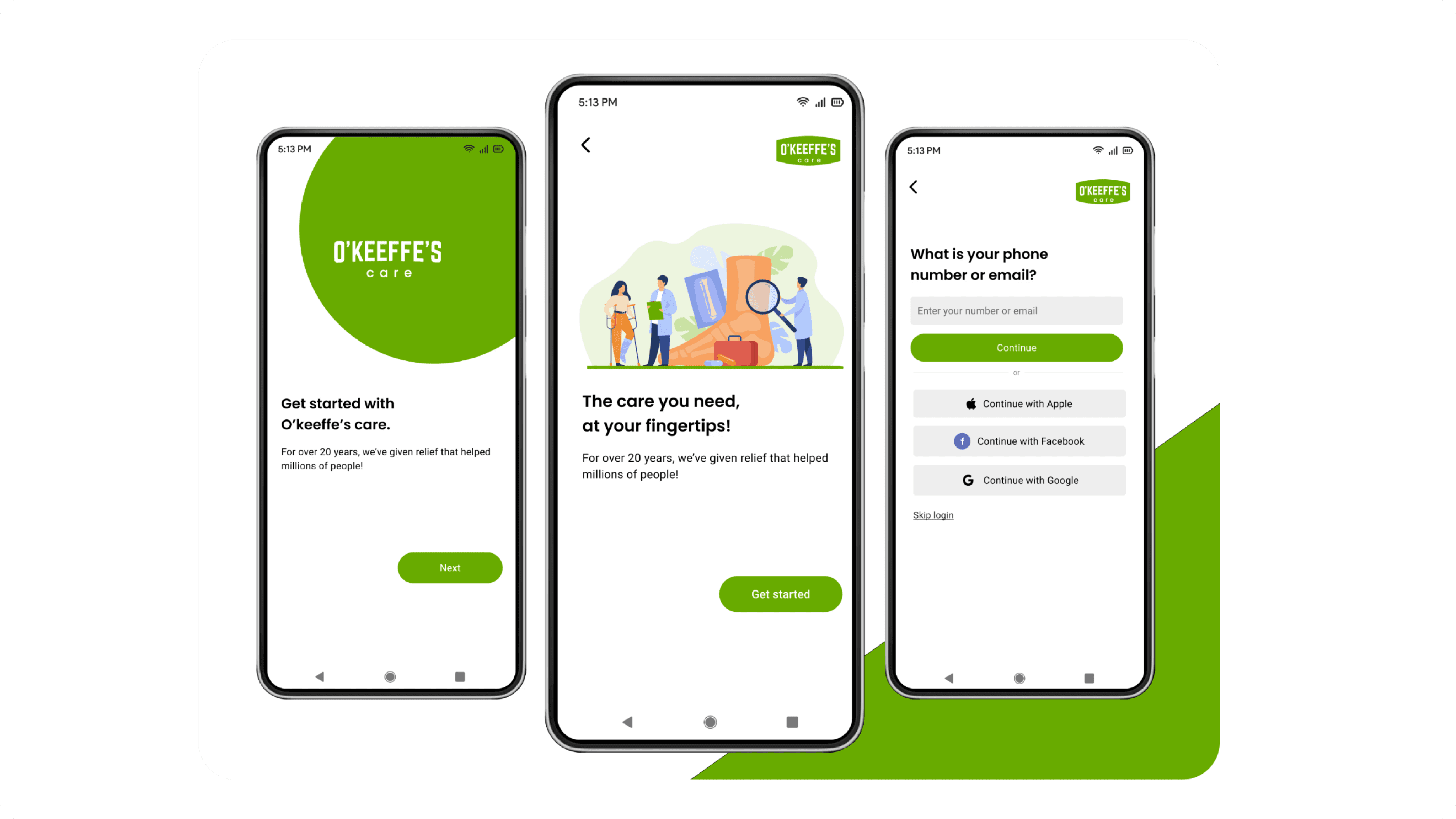
A twenty-year-old brand with a catalogue, not a store.
O’Keeffe’s Working Hands treats a specific, unglamorous problem: skin cracked from labour, weather or repetition. Its users range from children to the elderly, with a strong core of people in physically demanding trades, and it’s the number one hand cream brand in a US skincare market worth around twenty billion dollars.
What this project is. A self-initiated concept, not commissioned work. I had no access to O’Keeffe’s data, teams or roadmap; everything comes from their public site, published usability research and interviews I ran myself. Nothing shipped.
Evaluation
The live site scored against Baymard Institute e-commerce guidelines.
Research
Semi-structured interviews that moved the problem from the website to the product.
Concept
Visual severity assessment, dosage guidance, tracking and in-app purchase.
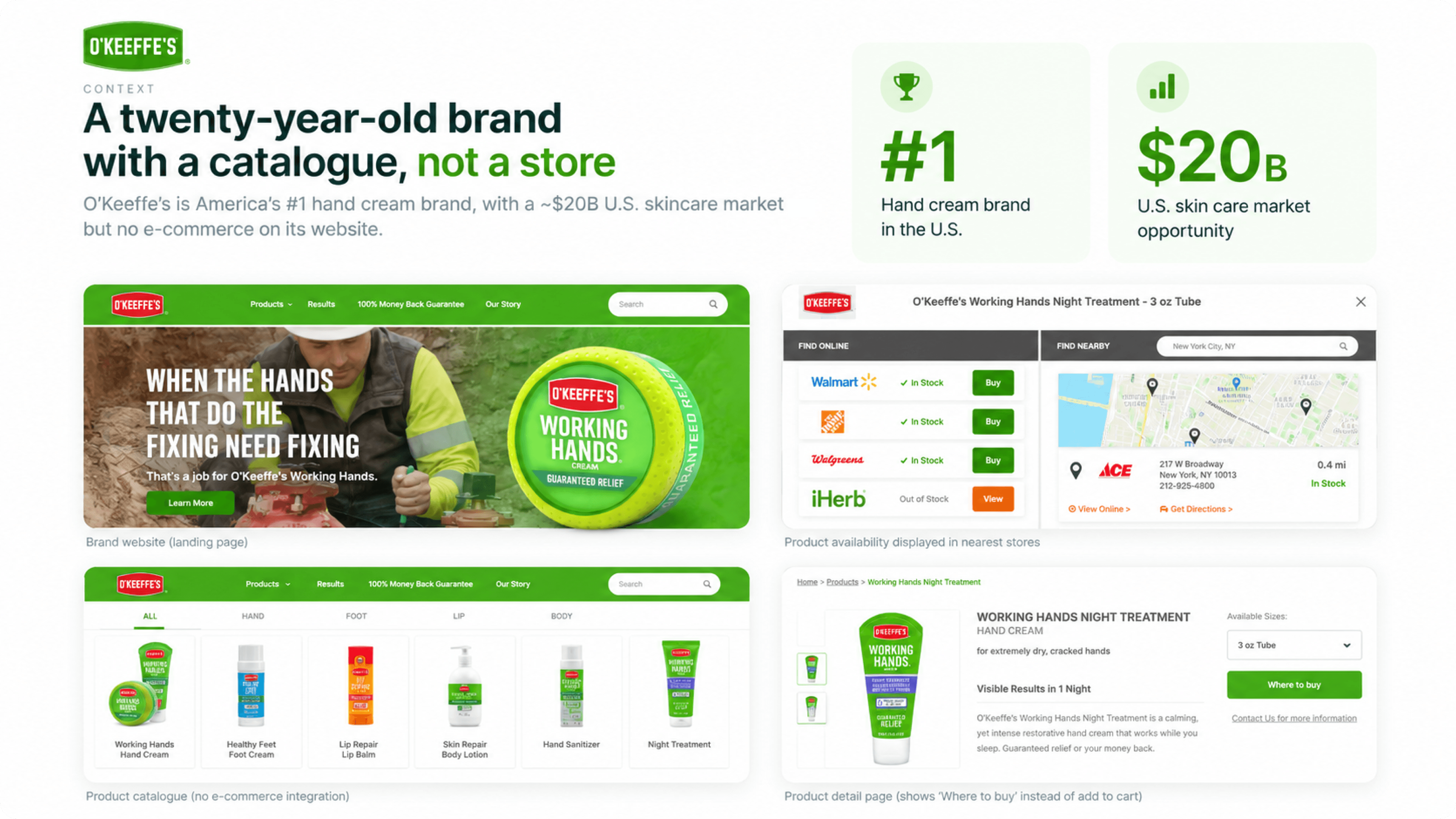
Every product page ended by sending you somewhere else.
Where an add-to-cart button belongs, the site had Where to buy, and behind it a store locator pointing at Walmart or Target. A customer with cracked hands reaches the brand that solves cracked hands, then gets handed to a shelf with no personalisation, no history and no guidance.
No way to buy from the brand directly
A wide range of similar-looking products
No guidance on which one fits how bad my hands are
No idea how much to use, or how often

The insight the concept is built on“The site’s failure wasn’t that you couldn’t buy. It was that even if you could, nothing told you what to buy or how to use it.”
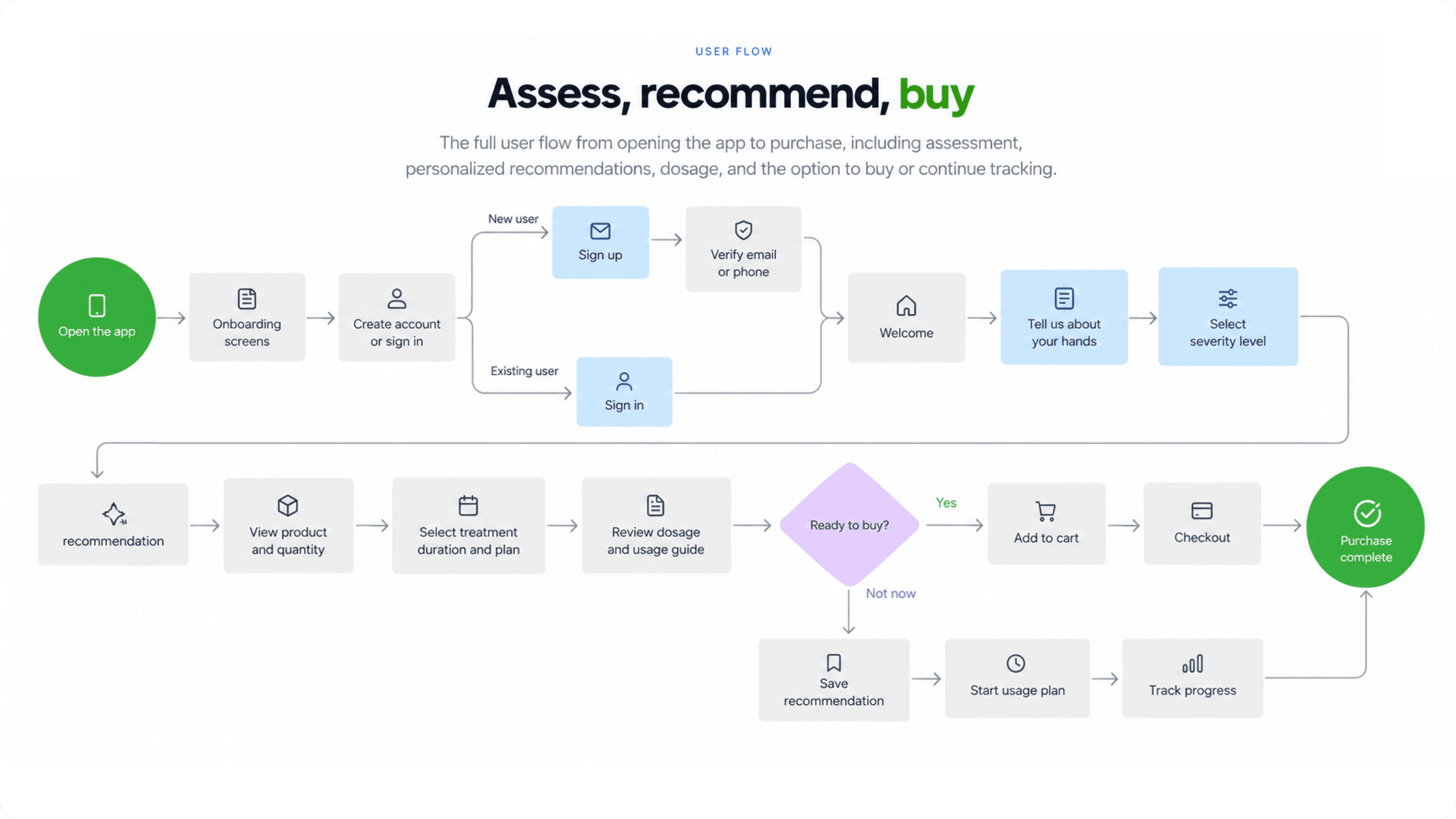
Assess, recommend, buy.
The primary persona isn’t a skincare enthusiast browsing a routine. It’s someone whose hands are cracked because of how they earn a living, who wants the problem addressed correctly in as few steps as possible. Efficiency isn’t a nicety in this flow. It’s the brief.
Point at a picture→Get a recommendation→Follow the plan→Buy in the app
The right product
A visual severity check and daily tasks drive a recommendation instead of a guess.
The right amount
Quantity, frequency and reminders tied to the severity selected.
The brand keeps the customer
Checkout, payment and order tracking stay with the brand that earned the trust.
Three challenges, three flows.
One sequence, with a route straight to purchase for anyone who already knows what they want.
Point at your hands, not a scale
Graded reference images of cracks and bruises at different intensities, plus a question about daily tasks. A comparison anyone can make in seconds.
How much, and how often
Every recommendation comes with quantity and frequency guidance, a schedule with reminders, and a daily treatment status so progress is visible.
And then the missing button
Recommended products go into a cart, checkout supports Apple Pay and familiar methods, and orders can be tracked afterwards.
Forty-five seconds to assess a condition. A minute to check out.
The prototype was tested with users for satisfaction and task timings. The timings matter most: they say whether this works for someone in a break room with ten minutes.
Overall satisfaction
Feature usefulness
Ease of use
To assess a condition; 2 min dosage, 1 min checkout
Self-initiated concept, tested with users; nothing shipped. Not affiliated with or endorsed by O’Keeffe’s Company.
- Before
- Where to buy, then a store locator
- After
- Assessment, recommendation and checkout with the brand
- Before
- Guessing which tube fits how bad your hands are
- After
- Pick the picture that looks like your hands
- Before
- No idea how much to use, or for how long
- After
- A dosage plan with reminders and visible progress
So, how did we get here?
From the concept, to the research that reshaped it.
Users barely talked about the website.
“This site is bad” is an opinion, so I first scored the live experience against Baymard’s guidelines. Then I ran semi-structured interviews, deliberately open-ended, so people could take me where the friction actually was. What came back was a persistent uncertainty about the products themselves.
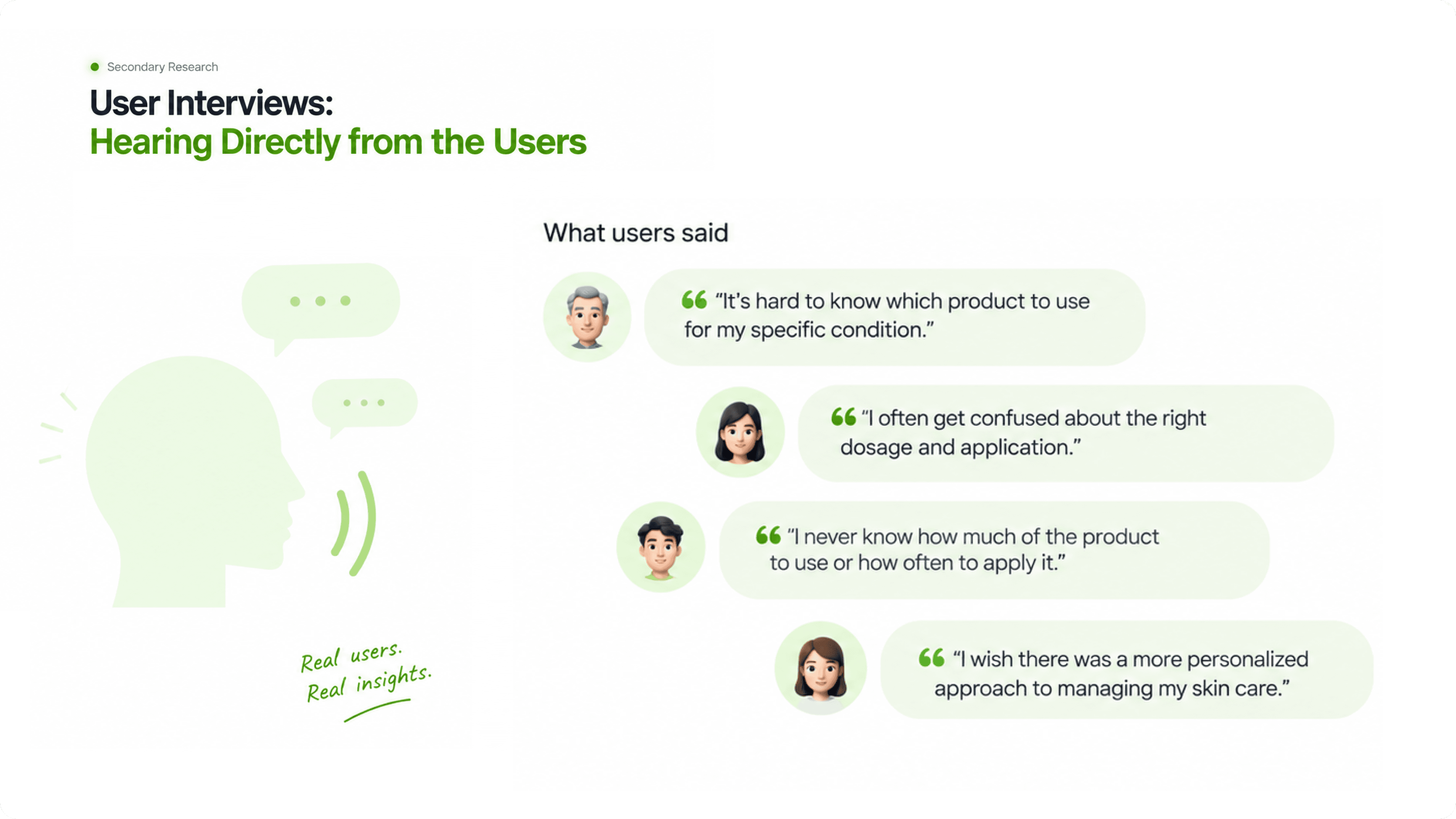
- Confusion
- Product selection confusion → personalised recommendations
- Generic
- No personalisation → treatment plans tied to a person
- Dosage
- Complex dosage decisions → severity-based assessment
- Duration
- Uncertainty about a plan → duration-based recommendations
- Habit
- Irregular usage → tracking, so people can see they did it
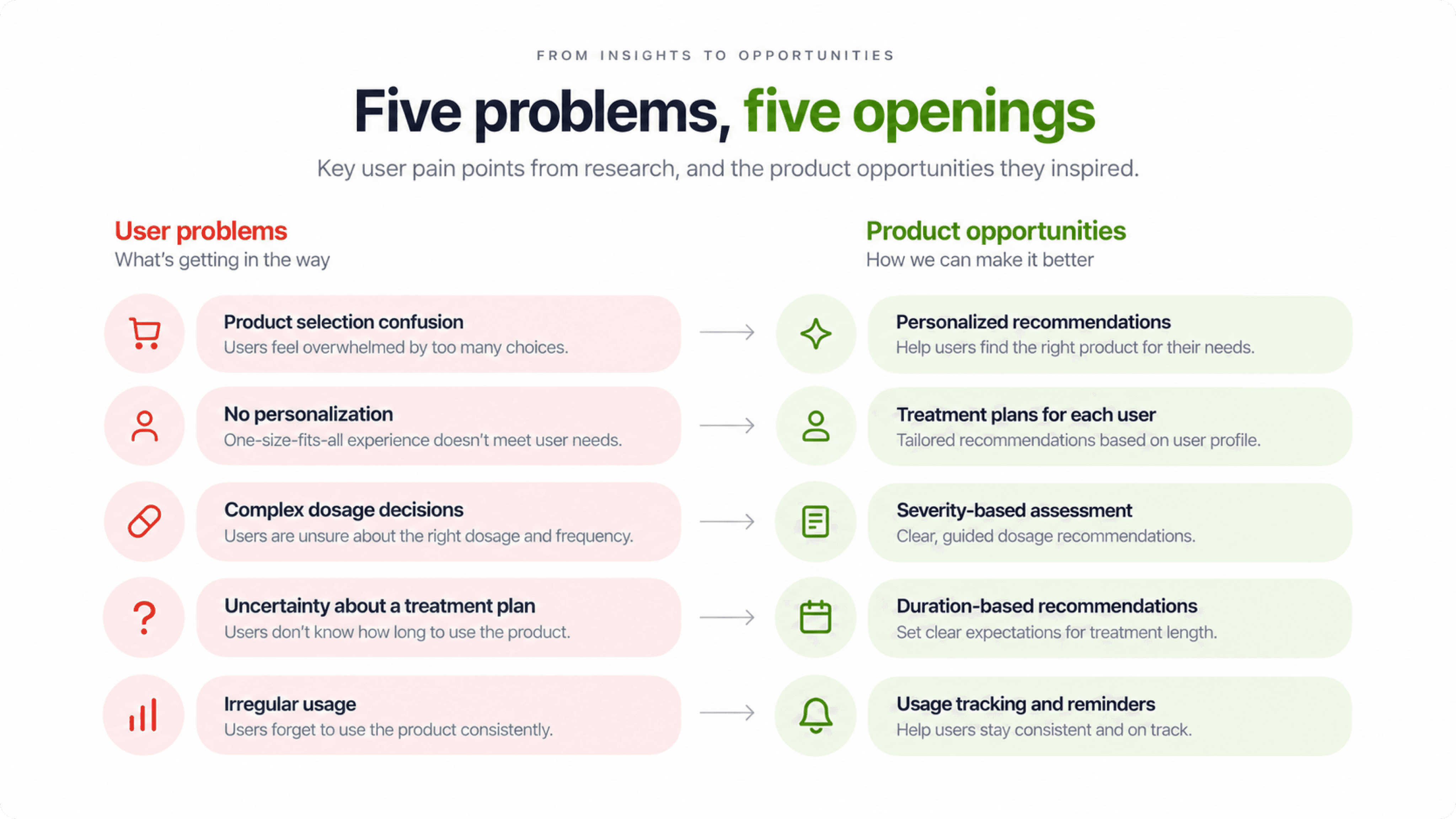
Four questions that shaped the concept.
Each started with more than one reasonable answer.
Fix the checkout, or fix the choice?
- Obvious
- Add the missing checkout. A competent e-commerce build that solves the wrong half.
- Decision
- Guidance first, commerce as the enabler. Every step before checkout is wasted if a third party takes the customer.

A self-rating scale, or a row of pictures?
Asking people to rate or name their skin condition assumes a vocabulary most don’t have. Moderate means nothing. Severe means nothing. Reference photographs turn a judgement into a comparison, and produce data a recommendation can trust. The interface choice was the accuracy decision.
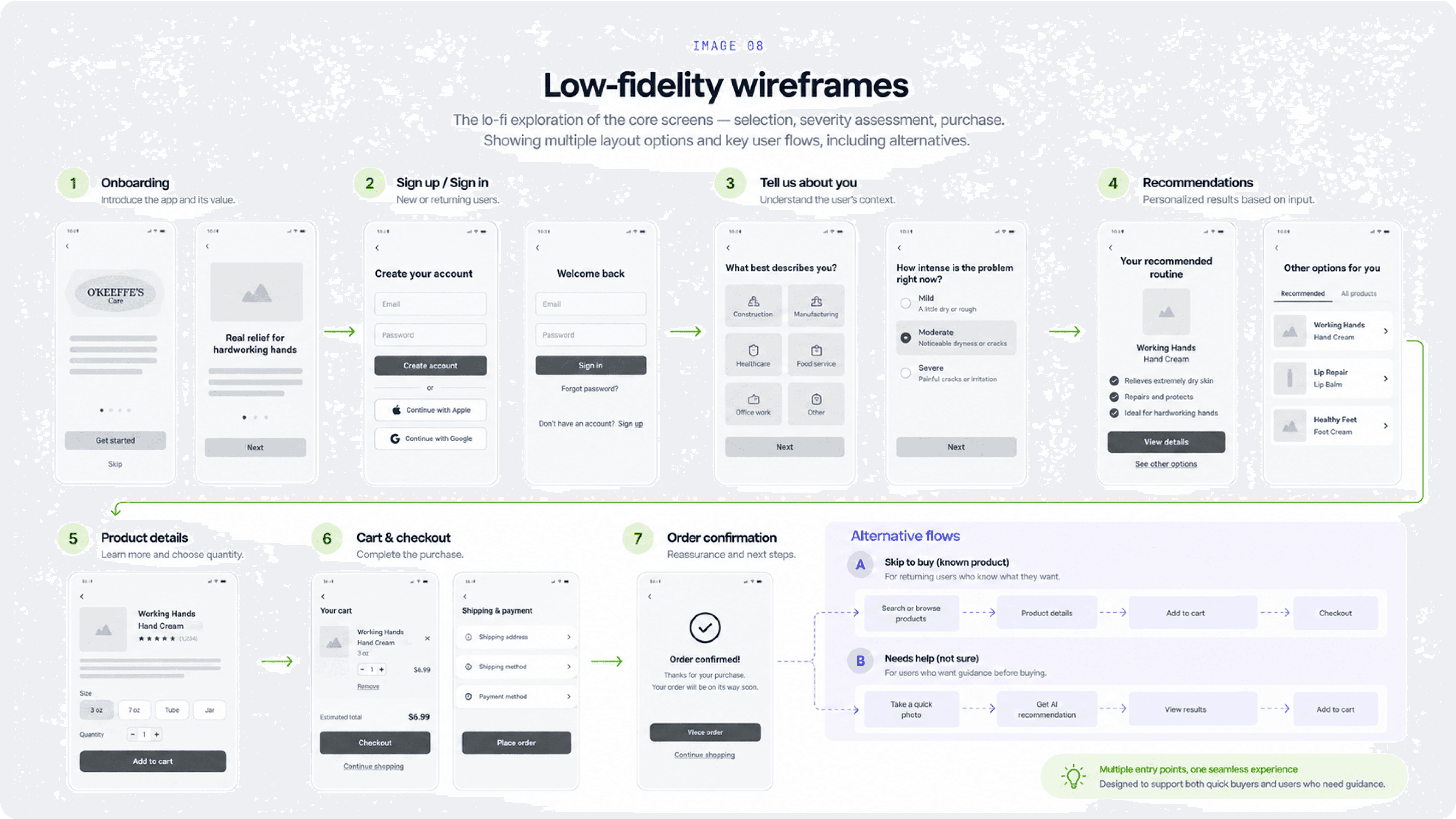
Sell the product, or support the treatment?
Buying the right product doesn’t help if it’s applied too thinly, twice a week, or abandoned after four days. So each recommendation carries a schedule, reminders and a daily status. An untracked treatment is one most people quietly stop doing.
How far should a skincare app go?
Assessing a condition and recommending a dosage sits close to regulated territory, where wellness guidance and medical advice are separated by a narrow, consequential line. As a real brief, that would shape the product before the interface did.
- 01
Regulatory and legal review first
Before a single recommendation rule is written.
- 02
Language that guides, not diagnoses
Careful wording throughout the assessment.
- 03
Clear routes to a clinician
For anything beyond ordinary dryness or cracking.
- 04
A narrower first release
Knowing which part to cut first is the difference between a concept and a product.
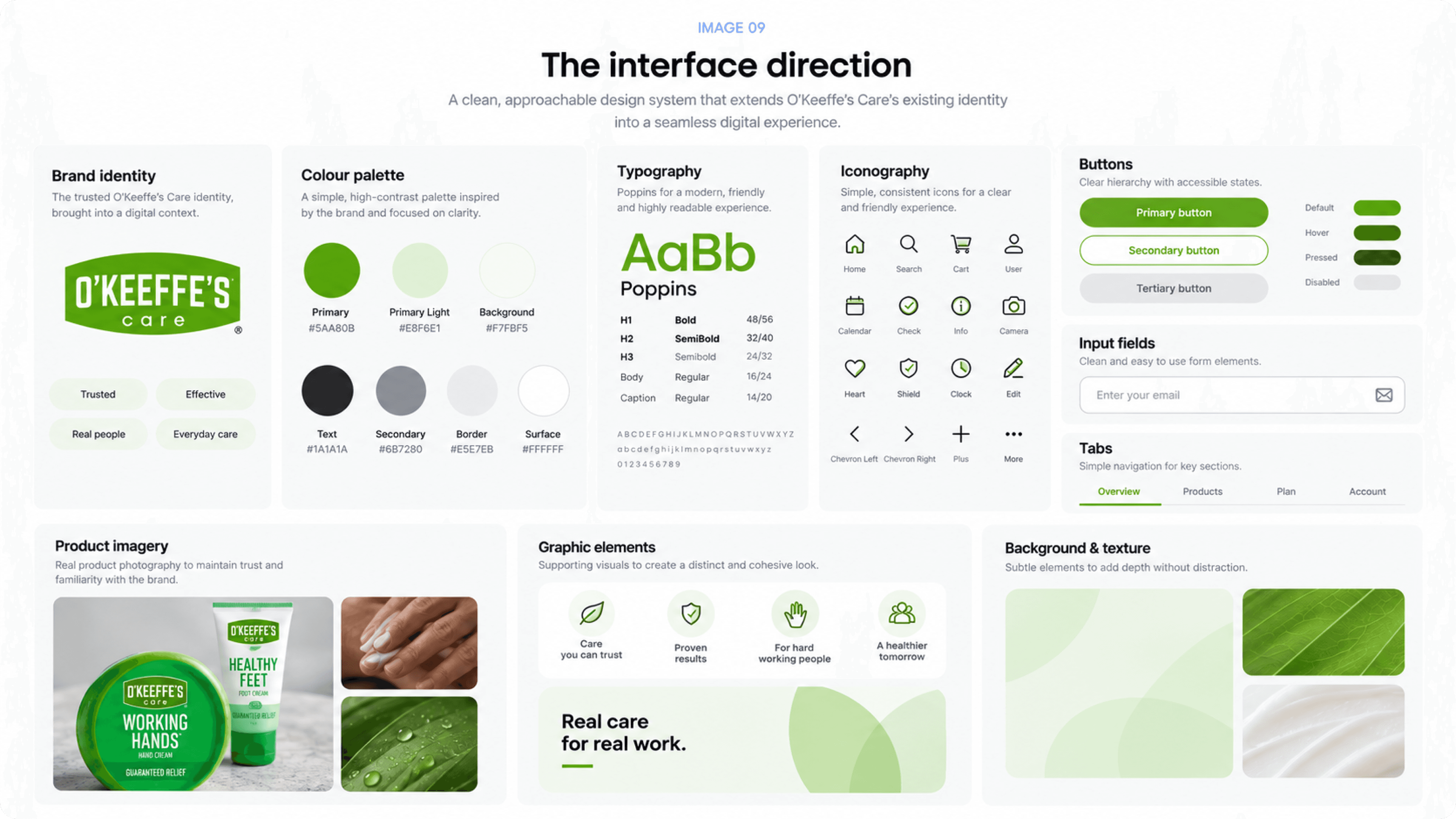
What the testing said.
Satisfaction ratings and task timings from usability testing of the prototype. The timings are measurements rather than opinions, which makes them harder to argue with than a satisfaction score.
- Severity
- 45 seconds to assess a condition
- Dosage
- 2 minutes to get a dosage recommendation
- Checkout
- 1 minute to buy

Expert skin care, anytime, anywhere.
The concept in motion: assessment, recommendation and purchase in one place.


What this one taught me
If I’d stopped at the heuristic evaluation, I would have designed a competent checkout that solved the wrong half of the problem.
- 01
Guidance was the product.
Users weren’t blocked by not being able to buy. They were blocked by not knowing what to buy, and then how to use it.
- 02
Input formats decide data quality.
Replacing a self-rating scale with reference photographs was an accuracy decision, not a visual one.
- 03
Meet regulated constraints early.
It doesn’t make the idea smaller. It tells you which version to build first.
The brand had spent twenty years earning trust. Then spent it at somebody else’s checkout.
O’Keeffe’s Care, self-initiated concept, 2023. Not affiliated with or endorsed by O’Keeffe’s Company; brand references identify the subject of an unsolicited design exercise.
Expert skin care
anytime, anywhere.


